arsgrammatica and Universal Dependencies
Universal Dependencies
The Universal Dependencies framework (UD) proposes annotation schemes for parts of speech, morphological features, and syntactic dependencies to apply across many languages, that have already been applied to more than 150 languages. UD is especially significant to Latinists because of Patrick Burns’ work on LatinCy, language models that work with the Python spaCy package for natural-language processing. Each token analyzed with spaCy has a head property linking it to another token in the syntax graph, and a dep_ property with the UD annotation for syntactic relationship (dependency).
udsyntax package
spaCy’s annotations for each analyzed token are extensive, but include many elements that are not helpful for Latinists (e.g., like_email, like_url). You can extract the syntactic relations from spaCy’s tokens into a simple syntactic graph structure with the udsyntax package.
A simple illustration
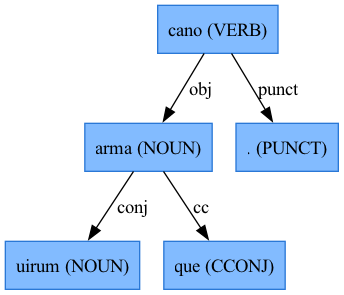
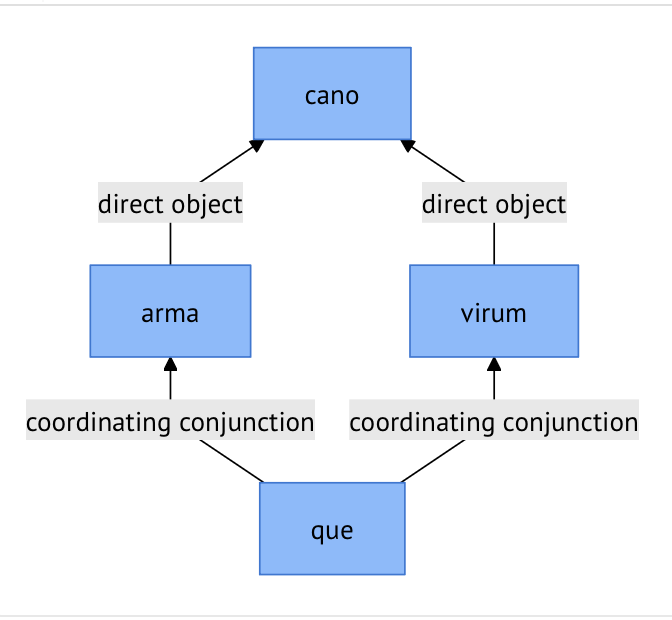
Consider a very short Latin sentence, and a visualization of the dependency graphs that UD annotation and arsgrammatica build for it.
arma virumque cano.
| UD | arsgrammatica |
|---|---|
 |
 |
Several features of the UD graph will seem odd to a Latinist. The UD has only one direct object (tagged obj) of the verb token cano. The noun uirum is tagged as a dependency of arma, in the relation tagged conj. The conjunction que is not related to virum but is a dependency of arma. The terminal period appears as part of the syntactic analysis.
arsgrammatica’s Latin-focused graph is a more natural representation for research questions like “What are the direct objects in this sentence?” In Latin classrooms, many teachers may find the UD representation unusuable or simply “wrong.” arsgrammatica’s representation more closely follows what students will find in Latin textbooks.
Two graph-theoretic details
The UD guidelines guarantee that all syntax graphs are trees. As this example shows, that is not true for
arsgrammatica’s directed graphs. In fact, althougharsgrammatica’s syntax graphs often approximate a tree structure, they are not guaranteed to be acyclic either: elements like relative pronouns have relations both to their antecedent and to their function in the relative clause, which can set up cycles. (See examples with relative pronouns in the documentation.)UD graphs are oriented with relations from root-level verbal structures flowing down;
arsgrammaticagraphs are oriented so that related elements from up to root-level verbal structures.