arsgrammatica and the AAT model
Agent-Action-Target (AAT) is a universal syntactic model, but it takes a very different approach from the Universal Dependency scheme. Instead of trying to map every syntactic feature of a given language onto a universal scheme, AAT is a reductive model focused on verbal ideas (actions), with their immediate subjects and objects (actors and targets). In Latin, AAT’s actors and targets correspond to subjects and direct objects of transitive active verbs, and to agents and subjects of transitive passive verbs. AAT’s graph maintains coordinated or subordinated ranking of its actions, so it is possible to construct a semantically compatible AAT graph using a subset of the tokens in arsgrammatica’s dependency graph.
The arsgrammatica package includes a function aatgraph that takes the sentence and token lists returned by arsgrammatica’s analysis functions and constructs an A-A-T graph. See this recipe.
A simple example
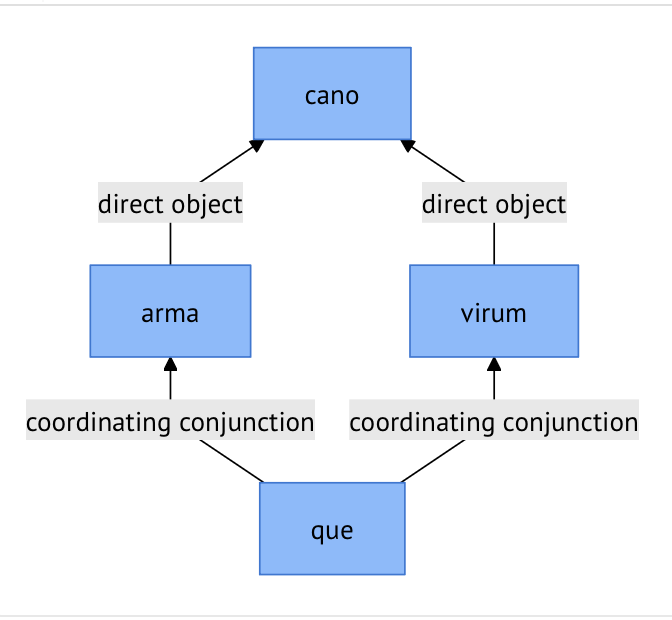
Consider a very short Latin sentence, and compare the visualization of the arsgrammatica dependency graphs with its AAT reduction.
arma virumque cano.
arsgrammatica
AAT reduction
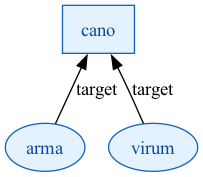
The similarity in their structure is obvious. Both graphs take cano for the root; the direct objects of the arsgrammatica graph correspond to the targets of the AAT graph. Note that the AAT reduction, working from the arsgrammatica tokenization where the enclitic -que was correctly handled as a distinct token from virum, omits the conjunction.
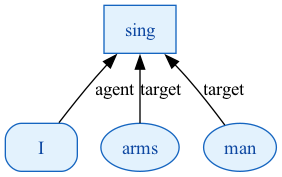
Now consider a possible English translation of the same passage. Since the aat package (https://github.com/neelsmith/aat) includes a module implementing the AAT scheme for English, we can juxtapse its AAT graph with the AAT reduction of the Latin passage.
I sing of arms and the man.
AAT graph of translation
AAT graph of Latin
This is a very simple example, but it at least suggests the potential of AAT models for comparing and aligning syntactic structure across languages. We can see that English explicitly names an agent (“I”), where in Latin that role is incorporated in the finite verb form cano; the action and the two targets in each language directly align.