Goals of arsgrammatica
Any computational analysis of natural-language syntax must choose a syntactic model suited to its purpose. Some analyses, for example, work with universal syntactic models like Universal Dependencies (UD) or Agent-Action-Target (AAT) to align features across multiple languages.
arsgrammatica addresses a different problem. It defines a syntactic scheme that is unique to Latin in order to support research and teaching focused on Latin texts. Some of its key features include:
arsgrammaticarespects citation of text passages. Tokens are uniquely citable within uniquely citable passages of text.- Syntactic categories use terminology already familiar to Latinists.
- Tokenization of Latin strings classifies tokens in terms specific to editions of Latin texts (e.g., it recognizes a
praenomentoken type written in abbreviated form and associated with a fully supplied Latin nomen or cognomen). - All lexical tokens are related in a dependency graph.
- The dependency graph is organized in coordinated and subordinated verbal expressions, subject-verb-object expressions generally corresponding to clauses in an English translation. (This structure is easily translated into an AAT model for cross-lingual alignment.)
A simple illustration
Consider a very short Latin sentence, and a diagram of the dependency graph that arsgrammatica builds from it.
arma virumque cano.
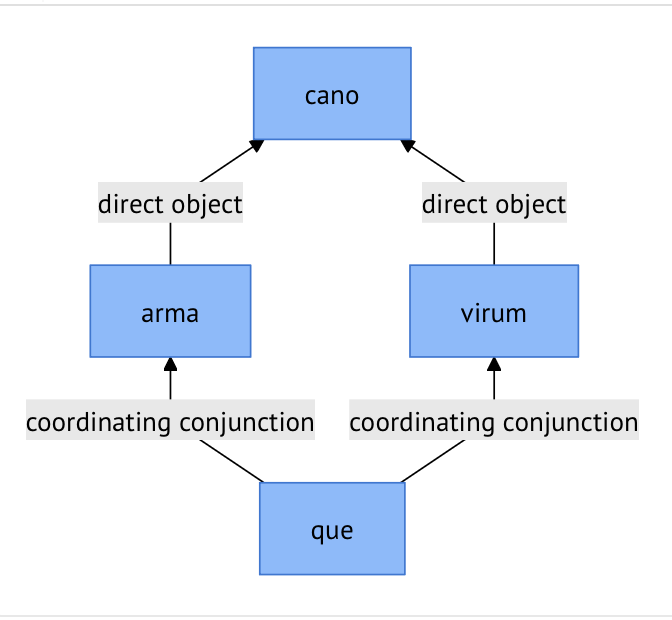
This Latin sentence contains a single verbal expression, rooted in the verb cano. arsgrammatica recognizes four lexical tokens in its dependency graph. It ignores the punctuation token (period), and distinguishes an enclitic token -que from the noun it is orthographically attached to (virum). arsgrammatica identifies two different kinds of relationship in this sentence: direct object and coordinating conjunction.