Historical linguistics and phonology
Similarities with linguistic and biological evolution
Historically observed:
- languages are always changing
- they do evolve into new languages
Hypothesized:
- do all languages descend from a common ancestor?
Differences from biological evolution
- mechanism for introducing change?
- what guides selection?
- languages can borrow from or be directly influenced by other languages
- our “fossil record” (written text) is only 5,000 years old!
(1-5 % of the time span of human language?)
When are two languages different?
- mutual intelligibility -> dialects of a single language
- all our examples are clearly distinct languages
How should we compare languages?
- syntax
- vocabulary
- external historical information
Syntax: how words are arranged
- English: word order determines function
- Latin: word form determines function
Two English sentences with different subject and object:
Dog bites man.
Man bites dog.
Two Latin sentences with same subject and object:
Homo canem mordet.
Canem homo mordet.
We’re ignoring syntax!
Vocabulary
Cognates: words in two languages that have the same origin (~ homology)
But pronounciation evolves! How do we identify cognates?
Testing possible cognates
- similar meaning
- systematic correspondences in cognates of two languages
- change in pronounciation can be explained phonetically
Phonetics
Simplistic model for our purposes:
- consonants only
- where the sound is made
- manner of producing the sound
- vocalized or not
Where the sound is made
- labial (lips) (e.g., English
p) - dental (teeth) (e.g., English
t) - palatal (top of mouth) (e.g., English
k) - velar (top of mouth at back) (e.g., German
ch)
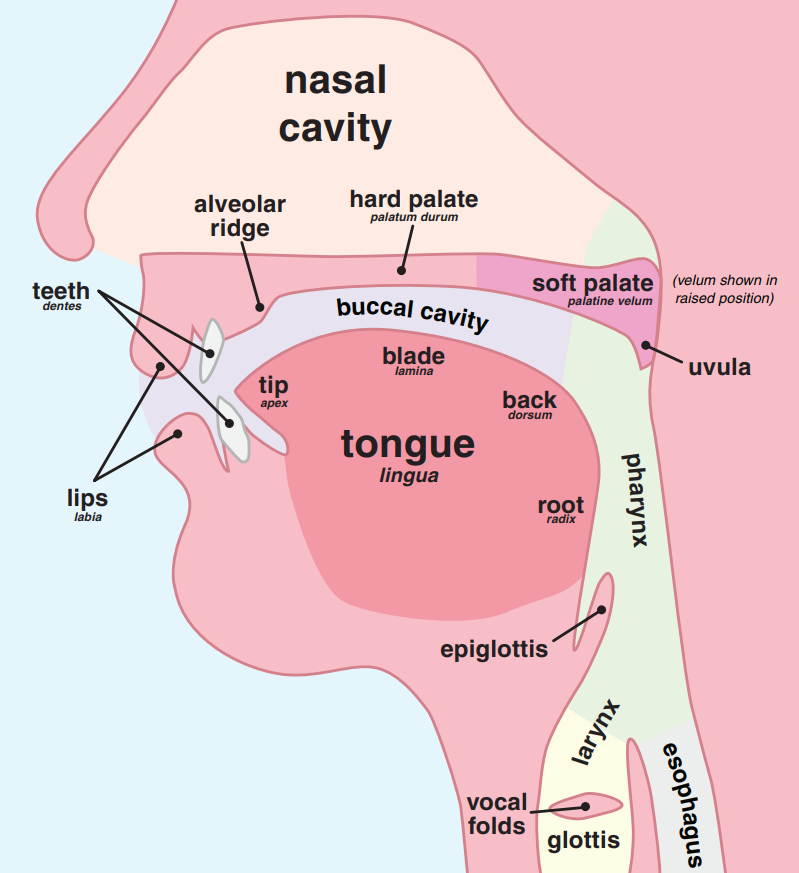
Manner of producing sound
- plosive: a little explosion of air (e.g., English
t) - fricative: a steady stream of air (e.g., English
th)
Vocalized
- voiced: vocal cords make a sound (e.g., English
d) - unvoiced: they don’t (e.g., English
t)
Summary example
English t: unvoiced dental plosive